A BreasKnowing Your Risk Saves Lives. Genetic Testing Helps You Stay One Step Aheadt Lump Isn’t Always Cancer
Some women are born with a higher risk of developing breast cancer — but with the right assessment, early screening, and expert guidance, that risk can be managed confidently.
At Prajnam, we help you understand your personal breast cancer risk and create a proactive plan tailored to your genetics, family history, and lifestyle.
What Is Genetic & Cancer Risk Assessment?
It is a detailed evaluation that helps determine your likelihood of developing breast cancer based on:
Family history
Personal health history
Breast density patterns
Age & hormonal factors
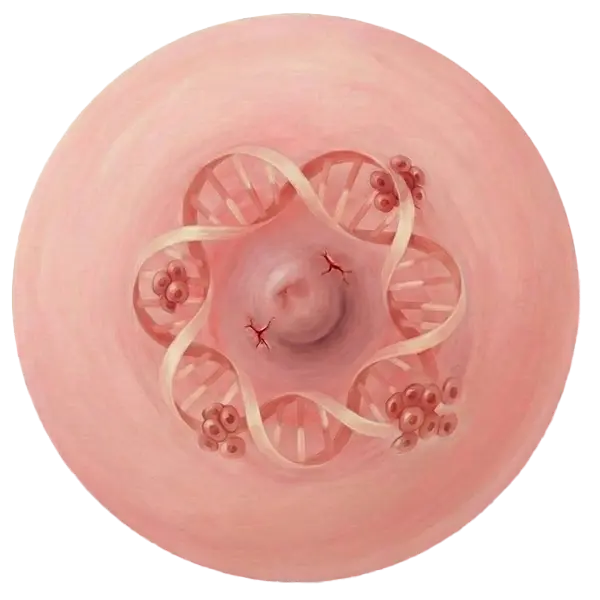
Genetic mutations
Lifestyle-related risk
This assessment helps us detect problems early – long before symptoms appear – giving you clarity, confidence, and control over your breast health.
Who Should Consider a Risk Assessment?
You should get a genetic or cancer risk evaluation if you have:
Family History of Breast Cancer
Especially in mother, sister, aunt, grandmother, or multiple relatives.
Known Genetic Mutations (BRCA1 / BRCA2)
Or history of ovarian, pancreatic, or prostate cancer in close relatives.
Breast Cancer at a Young Age in the Family
Diagnosis below age 50 increases risk.
Triple-Negative Breast Cancer in Family
More likely to have a hereditary cause.
Triple-Negative Breast Cancer in Family
Such as atypical hyperplasia or dense breast tissue.
Ashkenazi Jewish Heritage
Higher prevalence of specific genetic mutations.
If you’re unsure whether you fall into a high-risk category - a simple consultation can help.
What We Assess at Prajnam
Genetic Factors
BRCA1, BRCA2, and other gene mutations that elevate lifetime risk.
Family History Mapping
Your mother’s, sister’s, and extended family’s cancer history.
Hormonal & Reproductive Factors
Age at first period, first pregnancy, breastfeeding duration, menopause, etc.
Lifestyle-Linked Risks
Weight, diet, alcohol intake, and physical activity.
Breast Density & Imaging Pattern
Dense breasts can mask early signs; hence, advanced screening is essential.
Previous Breast Conditions
Cysts, papillomas, fibroadenoma, atypical cells, or prior biopsies.
This creates a personalised risk score and a clear plan for early detection.
How Genetic Testing Helps You
Detects risk before disease appears
Helps plan earlier or more frequent screening
Identifies hereditary causes
Guides family members who may also be at risk
Enables preventive lifestyle & medical decisions
Improves long-term outcomes through early detection
Genetics isn’t about fear – it’s about clarity and control.
When Should You See a Specialist?
You should book a Genetic & Cancer Risk Assessment if you have:
A first-degree relative with breast or ovarian cancer
A family member with BRCA mutation
A history of high-risk benign breast conditions
Dense breast tissue on imaging
Multiple cancers on one side of the family
Breast cancer diagnosed before age 50 in the family
Persistent anxiety about breast cancer risk
A first-degree relative with breast or ovarian cancer
Multiple cancers on one side of the family
A family member with BRCA mutation
Breast cancer diagnosed before age 50 in the family
Dense breast tissue on imaging
A history of high-risk benign breast conditions
Persistent anxiety about breast cancer risk

Frequently Asked Questions ?
No. It only means you need closer monitoring and early screening.
Your doctor will guide you based on your family history and risk factors.
Yes – even if some family members didn’t get cancer, the mutation can still be passed on.
We create a personalised screening and prevention plan to detect issues early.
Yes. It is a simple blood or saliva test with no physical risks.
Still unsure about your breast cancer risk?
Let our breast expert guide you with
Still unsure about your breast cancer risk?
Let our breast expert guide you with
expert ultrasound and minimally-invasive scarless treatments – all in one place.
Breast Conditions
Contact Us
39 & 40 Ground Floor, M2K Corporate Park,
Sector 51, Gurgaon