Best Breast Specialist Doctor in Gurgaon | Prajnam Breast Clinic
Trusted by 11000+ women for Modern Diagnostics and Scarless Treatment of Breast Ailments under one roof

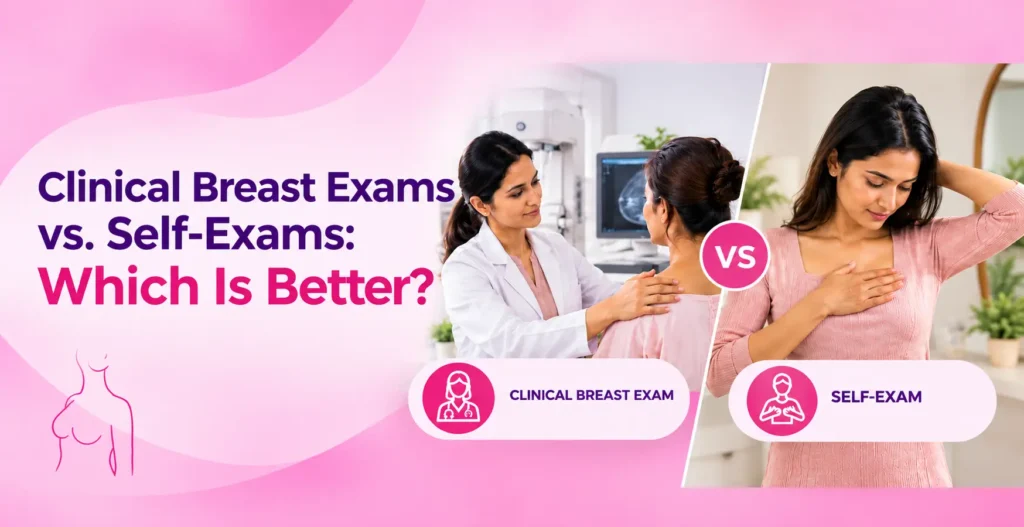
Clinical Breast Exams vs. Self-Exams: Which Is Better?
You notice something different in your breast while showering or getting dressed. Your first thought may be, “Should I keep checking it myself, or should I see a doctor?”
Breast self-checks and clinical breast exams are not the same thing. One helps you notice changes, while the other helps a healthcare professional evaluate them.
So, which is better? The answer lies in understanding what each one can and cannot do.
What Is a Breast Self-Exam?
A breast self-exam involves looking at and feeling your breasts for changes such as:
- a new lump or thickening
- changes in breast size or shape
- skin dimpling or puckering
- nipple retraction or unexpected discharge
- unusual swelling or redness
- changes in the armpit
However, the focus today is increasingly on breast self-awareness rather than following a rigid monthly self-examination routine.
Breast self-awareness simply means knowing how your breasts normally look and feel so that you are more likely to notice something new.
What Is a Clinical Breast Exam?
A clinical breast exam is performed by a trained healthcare professional.
The doctor examines your breasts and surrounding areas for lumps, changes in breast shape or skin, nipple abnormalities and changes in the armpits.
Importantly, a doctor can consider these findings alongside your age, symptoms, medical history and family history.
This clinical context cannot be obtained through a self-check alone.
Which One Is Better?
They serve different purposes.
Breast self-awareness helps you notice a change.
A clinical breast exam helps a healthcare professional evaluate that change.
Neither one, however, should be considered a replacement for recommended breast cancer screening through mammography.
A self-exam also cannot tell you whether a breast lump is cancerous. Many breast lumps are caused by benign conditions such as fibroadenomas and cysts, but the cause cannot reliably be determined by touch alone.
Similarly, a clinical breast exam may identify an abnormality, but it cannot by itself confirm or rule out breast cancer.
Further evaluation through breast ultrasound, diagnostic mammography or, in some situations, biopsy may be required.
When Should You See a Breast Doctor?
Speak with a breast doctor when you notice:
- a new breast or armpit lump
- persistent breast pain
- unexpected or bloody nipple discharge
- a nipple that has recently turned inward
- skin dimpling or puckering
- unexplained redness or swelling
- a new change in breast size or shape
Do not wait for your next routine screening appointment when something new or unusual appears.
At Prajnam Breast Centre, breast care includes breast expert consultation, 2D and 3D digital mammography, advanced breast ultrasound and image-guided biopsy when clinically required.
Know Your Normal. Know When to Go Further.
Breast self-awareness, clinical examination and mammography each have different roles in breast health.
You do not need to decide whether a lump feels “suspicious” or whether a change is serious enough.
Your role is simpler: